

 What Is Keyword Research?
Let me be honest with you for a second.
When I first heard the phrase “keyword research,” I pictured some kind of dark art practiced by tech wizards in hoodies. Something mysterious, deeply technical, and probably not meant for regular humans.
Turns out? It’s not that complicated. In fact, once you get the hang of it, keyword research becomes one of the most satisfying parts of building a content strategy. Because it’s basically learning to read minds — figuring out exactly what your audience is typing into Google and then showing up with the perfect answer.
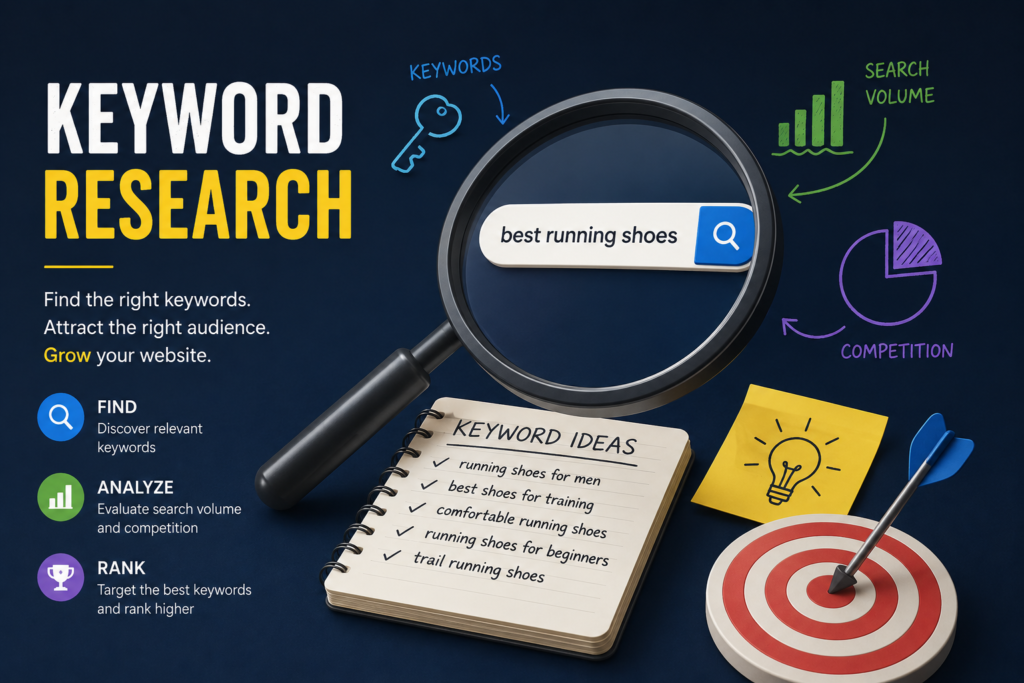
Keyword research is the process of finding the words and phrases that people use when they search for something online — and then deciding which of those words are worth targeting with your content.
Think of it this way: every time someone searches “best running shoes for flat feet” or “how to make sourdough bread at home,” they’re telling you exactly what they want. The entire point of keyword research is to collect all those signals, understand what they mean, and build content that genuinely answers them.
When done right, it’s the foundation of everything — your blog posts, landing pages, YouTube videos, product descriptions, all of it.
📖 Further Reading: Google’s own explanation of how Search works — worth five minutes of your time to understand what you’re ultimately optimising for.
Why Keyword Research Matters
 Here’s a scenario. You spend three weeks writing a 3,000-word blog post. It’s well-researched, beautifully written, and genuinely helpful. You hit publish and… nothing. Crickets.
What went wrong? Probably this: nobody was searching for it.
This is the core problem that keyword research solves. It helps you stop creating content in a vacuum and start creating content that people are actively looking for. It’s the difference between shouting into the void and having a real conversation.
Beyond that, good keyword research helps you:
- Understand your audience better — what they care about, how they phrase things, what problems they’re trying to solve
- Spot content gaps — topics your competitors haven’t covered well yet
- Prioritise your time — so you focus on high-impact content first
- Improve your rankings over time — because Google rewards relevance and intent-matching
📖 External Resource: Backlink’s SEO Ranking Factors Study is one of the most data-backed looks at what actually drives rankings. Highly recommended reading alongside any keyword strategy work.
Step 1: Build Your Seed List
Before you open any fancy tool, grab a piece of paper (or open a doc) and brainstorm.
Ask yourself: What would my ideal reader type into Google?
If you run a fitness blog, your seed keywords might be things like:
- weight loss tips
- home workout routine
- how to build muscle
- nutrition for beginners
These are broad, high-level terms. They’re not your final targets — they’re starting points. Seeds. You plant them, and the keyword research process helps them grow into something far more useful.
A few ways to come up with seed keywords:
- Think like your customer. What questions do they ask you most? What problems keep coming up?
- Look at your competitors’ websites. What topics do they keep writing about?
- Check your own analytics. What are people already finding you for?
- Browse Reddit, Quora, and niche forums in your space. People are incredibly honest about what confuses them.
- Use Google Trends to see what’s rising in your niche right now.
💡 Pro Tip: Also check the “People Also Ask” boxes on Google. Those questions are gold — they show you exactly what related things people are wondering about.
Step 2: Expand With Keyword Research Tools
Now it’s time to take your seeds and see what grows. Keyword research tools are what make this process scalable — you go from a handful of ideas to hundreds of opportunities in minutes.
Here are the main ones worth knowing:
🔵 Google Keyword Planner
Free. Straight from the source. Great for search volume data and discovering related keywords. You’ll need a Google Ads account to access it, but you don’t need to run ads.
→ Access Google Keyword Planner
🟠 Ahrefs
The gold standard for many SEOs. Paid, but incredibly powerful. You can see search volume, keyword difficulty, competitor rankings, and much more. Their free keyword generator is a good starting point.
🟣 SEMrush
Similar to Ahrefs. Great for competitive research, tracking rankings over time, and their keyword magic tool is genuinely impressive.
🟢 Ubersuggest
Neil Patel’s tool — more affordable, good for beginners. Does most of what you need at a fraction of the price.
🔍 Google itself
Seriously. Type something into Google and look at the autocomplete suggestions. Scroll to the bottom and check “People Also Ask” and “Related Searches.” That’s free keyword research hiding in plain sight.
What to look for in these tools:
When you drop your seed keywords in, you’ll get a list of related keywords with data attached. The two numbers you care most about are:
- Search Volume — How many people search for this per month
- Keyword Difficulty (KD) — How hard it will be to rank for this term
Step 3: Understand the Types of Keywords
Not all keywords are created equal. Before you start choosing targets, you need to understand the landscape.
Short-tail vs. Long-tail Keywords
Short-tail keywords are broad, one or two-word phrases. Think “running shoes” or “email marketing.” They attract massive search volumes, but they’re incredibly competitive and a bit vague. When someone searches “running shoes,” what do they actually want? To buy? To compare? To learn about types?
Long-tail keywords are longer, more specific phrases. “Best running shoes for flat feet women under $100.” Far fewer people search this, but the ones who do know exactly what they want — and that makes them much easier to rank for and far more likely to convert.
As a rule of thumb: if you’re starting out, long-tail keywords are your best friends. They’re easier to win and often more valuable per visitor.
📖 External Resource: Moz’s Beginner’s Guide to SEO has an excellent breakdown of keyword types with real examples. It’s one of the best free resources on the internet for learning SEO fundamentals.
Informational, Navigational, and Transactional Keywords
This is about search intent — what the person actually wants when they type something in.
| Intent Type | What They Want | Example | Best Content Type |
|---|---|---|---|
| Informational | To learn something | “how does SEO work” | Blog posts, guides, videos |
| Navigational | To find a specific site | “Spotify login” | Not usually targeted |
| Transactional | To buy or take action | “best CRM software” | Product pages, reviews |
| Commercial | To compare before buying | “Ahrefs vs SEMrush” | Comparison articles |
Understanding intent is everything. Ranking for a keyword is only valuable if you’re giving people what they actually came for.
Step 4: Evaluate and Prioritise Your Keywords
By now you probably have a long list. Maybe hundreds of keywords. The question is: which ones do you actually go after?
Here’s the framework I use:
The Goldilocks Rule: Not Too Hard, Not Too Easy
You want keywords with enough search volume to be worth targeting, but not so competitive you’d never rank for them.
If you’re a new website, chasing keywords with a difficulty score of 70+ is basically a waste of time. Target lower-difficulty keywords first, build authority, then work your way up.
| Site Authority | Target Keyword Difficulty |
|---|---|
| New site (DA 0–20) | KD 0–20 |
| Growing site (DA 20–40) | KD 20–40 |
| Established site (DA 40+) | KD 40–60+ |
Think About Business Value
High search volume is great. But will the person searching this actually become your customer?
A keyword like “what is email marketing” might get 50,000 searches a month. But if you sell email marketing software, you want people who are ready to sign up — not just curious. Always ask: is this keyword bringing in the right audience?
Consider the Competition
Look at who’s currently ranking for a keyword. If it’s all massive publications — Forbes, Healthline, Wikipedia — you’re probably not going to beat them any time soon. Look for gaps where smaller, niche sites are ranking. That’s your opportunity.
💡 Quick Tip: Use Ahrefs’ or SEMrush’s “SERP overview” to check the Domain Rating of pages currently ranking. If the top 10 are all DR 80+, step back and find a less contested angle.
Step 5: Analyse Search Intent
I’ve already touched on this, but it’s important enough to get its own step.
Before you write a single word, Google the keyword yourself. Look at the top 5–10 results. Ask:
- What type of content is ranking? Blog posts? Videos? Product pages? Tools?
- What format is it in? Listicles? How-to guides? In-depth essays?
- What angle are they taking? Beginner-friendly? Expert-level? Personal stories?
This tells you exactly what Google thinks people want when they search that term — and that’s what you need to deliver.
If all the top results are “10 best X” listicles, that’s a signal. If they’re all detailed how-to guides, that’s a different signal. Don’t fight the format. Work with it.
📖 External Resource: Ahrefs has a brilliant deep-dive on search intent and SEO that’s worth bookmarking. It goes much deeper than what we’ve covered here.
Step 6: Map Keywords to Your Content
Once you’ve got your keyword targets, figure out what content they belong in.
A powerful approach is the content pillar strategy (also called topic clusters):
PILLAR PAGE: "Content Marketing: The Complete Guide"
    │
    ├── Cluster: "How to Write a Content Brief"
    ├── Cluster: "Content Marketing for B2B Companies"
    ├── Cluster: "How to Measure Content ROI"
    ├── Cluster: "Content Calendar Templates"
└── Cluster: "Content Marketing Tools"- Pick a broad pillar topic and create one comprehensive, authoritative page
- Create cluster pages around specific subtopics
- Internally link all cluster pages back to the pillar
This signals to Google that you’re a genuine authority on the subject — not just someone who wrote one article and moved on.
One keyword per page, please. A common mistake is trying to rank one page for twenty different keywords. Each piece of content should have one primary keyword and a handful of related secondary keywords. Keep it focused.
📖 External Resource: HubSpot coined the pillar-cluster model and wrote a definitive guide to topic clusters that’s still the clearest explanation out there.
Step 7: Track, Measure, and Adjust
Keyword research isn’t a one-time thing. It’s an ongoing process.
Once your content is live, track how it’s performing. Google Search Console (completely free) shows you which queries people are using to find your pages, how many impressions you’re getting, and where you’re ranking.
After a few months, come back to underperforming pages and ask:
- Is the content actually answering the search intent?
- Does it need to be more comprehensive?
- Are there related keywords I’m missing?
- Do I need more backlinks to compete?
Update old content regularly. Google loves fresh, relevant pages — and sometimes a solid update is all it takes to jump from position 8 to position 2.
💡 Tools for tracking: Google Search Console (free), Ahrefs Rank Tracker, SEMrush Position Tracking.
Common Mistakes to Avoid
Since we’re being real with each other, let me save you some pain:
❌ Chasing volume over intent. A keyword with 100,000 monthly searches is useless if the people searching it don’t want what you’re offering.
❌ Ignoring long-tail keywords. These are where most of the early wins happen, especially for newer sites.
❌ Doing keyword research once and forgetting it. Trends change. New keywords emerge. Competitors shift strategy. Revisit your keyword research every quarter at minimum.
❌ Keyword stuffing. This is a relic of 2010 SEO. Google is smart now. Write for humans first. Use keywords naturally. Forcing “keyword research” into every sentence actually hurts you.
❌ Ignoring your existing content. Sometimes your best move isn’t creating new content — it’s optimising what you already have. Run a content audit before you do new keyword research.
❌ Skipping competitor analysis. Your competitors have already done a lot of research. See what’s working for them, then do it better.
Quick Keyword Research Checklist
Before you start writing any piece of content, tick every box:
- I’ve identified a clear primary keyword
- I know the search intent behind this keyword
- The search volume justifies the effort
- The keyword difficulty is realistic for my site’s current authority
- I’ve checked what’s currently ranking and understand the required format
- I have secondary keywords to use naturally throughout the content
- This keyword maps to a specific page (no overlap with existing content)
- I’ve set up tracking in Google Search Console or a rank tracker
Wrapping Up
Here’s the thing about keyword research — it doesn’t create success on its own. It’s a foundation.
Once you know what to write about, you still have to write it well. You have to answer the question better than everyone else. Structure it clearly, make it genuinely useful, earn links to it, and keep it updated over time.
But none of that matters if you’re writing about the wrong things. That’s why keyword research comes first, every time. It’s the compass that points your entire content strategy in the right direction — and keeps you from wasting months on content nobody ever asked for.
Start small. Pick five keywords this week. Write content around them. See what happens. Then do it again. Over time, you’ll develop an intuition for what works — and that’s when the results start compounding.
Good luck out there.
Have questions about keyword research? Drop them in the comments — I read every single one. If you want us to do it for you feel free to click this link Contact
Recommended Resources & External Links
Here’s everything linked throughout this guide, plus a few bonus resources worth bookmarking:
🛠️ Keyword Research Tools
| Tool | Best For | Pricing |
|---|---|---|
| Google Keyword Planner | Beginners, free volume data | Free |
| Ahrefs Keywords Explorer | In-depth research, competitor analysis | Paid |
| SEMrush Keyword Magic Tool | Large-scale research, tracking | Paid |
| Ubersuggest | Affordable alternative | Free/Paid |
| Google Trends | Trending topics, seasonal keywords | Free |
| Google Search Console | Tracking what you already rank for | Free |
📚 Guides Worth Reading
- Moz – Beginner’s Guide to SEO — The classic starting point
- Ahrefs – How to Do Keyword Research for SEO — One of the most thorough free guides available
- Backlinko – Keyword Research: The Definitive Guide — Brian Dean’s always-updated masterclass
- HubSpot – Topic Clusters & Pillar Pages — For content mapping strategy
- Google – How Search Works — Understanding the system you’re optimising for
- Search Engine Journal – Keyword Research Guide — Practical, regularly updated
- Neil Patel – The Complete Guide to Keyword Research — Great for beginners
📋 Table of Contents
- What Is Keyword Research?
- Why Keyword Research Matters
- Step 1 – Build Your Seed List
- Step 2 – Expand With Keyword Research Tools
- Step 3 – Understand the Types of Keywords
- Step 4 – Evaluate and Prioritise Your Keywords
- Step 5 – Analyse Search Intent
- Step 6 – Map Keywords to Your Content
- Step 7 – Track, Measure, and Adjust
- Common Mistakes to Avoid
- Quick Keyword Research Checklist
- Wrapping Up
- Recommended Resources & External Links

One Comment