

PPC vs SEO: Where Should You Invest First?
Choosing between paid search and organic search often comes down to one question: do you need results now, or do you want to build a durable traffic asset over time? In most cases, the smartest answer is not “either/or,” but deciding which one deserves the first dollar based on your goals, timeline, and budget.
PPC vs SEO at a Glance
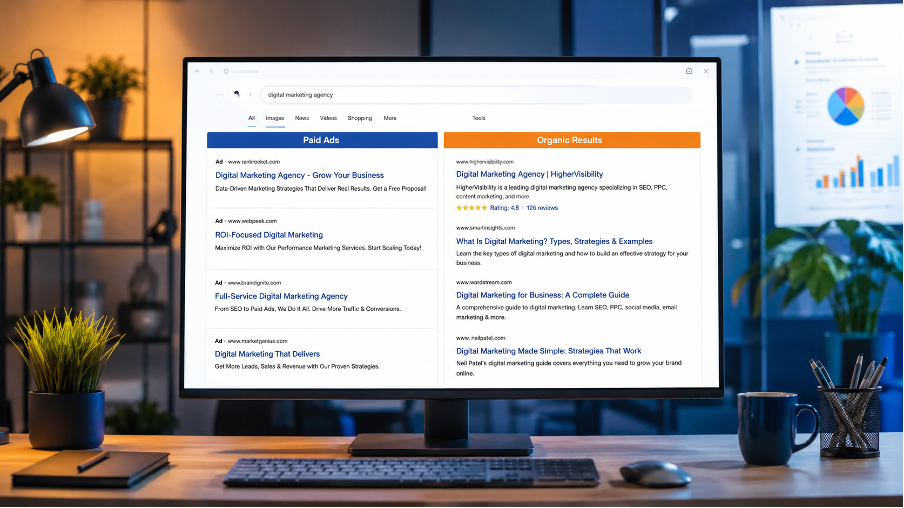
SEO focuses on improving your website so it ranks in organic search results, while PPC places paid ads in search results and charges you for clicks. Google describes SEO as improving content quality, structure, and discoverability, while PPC gives immediate visibility through paid placement.
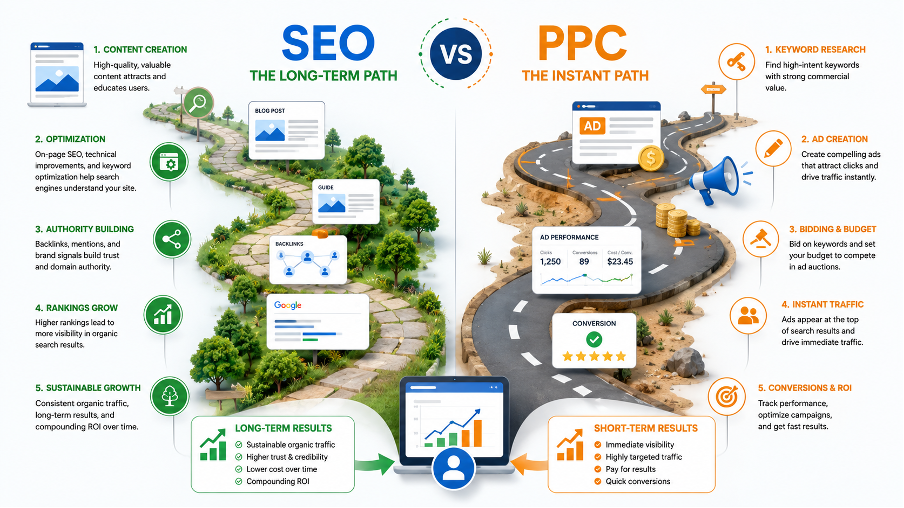
A useful way to think about them is this: SEO is like building a store in a great location, while PPC is like renting the most visible billboard on day one. PPC can generate traffic immediately, but SEO tends to compound over time and can continue producing traffic after the initial work is done. Choosing wisely between PPC vs SEO is important .
What Is SEO and How Does It Work?
Before jumping onto one it is important to know the basic difference between PPC vs SEO and importance and limitations of each . SEO, or search engine optimisation, enhances a website’s visibility in search engines through keyword research, content creation, technical optimisation , internal linking, and link building, ultimately improving rankings for relevant queries. Higher rankings lead to greater click-through rates, with the top position capturing about 28.5% of clicks, while lower positions see significantly less.
Benefits and Limitations of SEO
The biggest benefit of SEO is compounding value. Once a page ranks well, it can bring consistent traffic without paying for every click, which makes it especially attractive for companies thinking long term.
The limitation is time. SEO rarely delivers meaningful results instantly, and competitive keywords may take months of content work and authority building before they move. It also requires ongoing maintenance because rankings can shift as competitors publish better content or search intent changes.
What Is PPC and How Does It Work?
PPC, or pay-per-click advertising, is a model where you bid on keywords and pay each time someone clicks your ad. In search marketing, it usually means Google Ads or other search ad platforms that show sponsored listings above organic results.
PPC is designed for speed and control. You can target specific keywords, locations, devices, and audience segments, then measure performance almost immediately. That makes it useful when you need traffic fast or want to test offers before investing heavily in content.
Benefits and Limitations of PPC
PPC’s main strength is immediacy. A campaign can start bringing qualified visitors the same day it launches, which is especially helpful for product launches, promotions, and lead-generation needs with short timelines. It also offers tight control over targeting and messaging, letting you adjust bids, budgets, and ad copy quickly.
Its main weakness is cost dependency. Traffic stops when the budget stops, and competitive keywords can become expensive, especially in high-intent industries. PPC can also become less efficient if landing pages are weak, conversion tracking is poor, or the account is not monitored closely.
When Should You Invest in PPC First?
PPC should come first when speed matters more than long-term accumulation. If you are launching a new product, running a time-sensitive offer, entering a new market, or need lead flow immediately, paid search can give you data and visibility right away.
It is also useful when you need to validate demand before making a larger SEO investment. For example, if you are unsure which keywords convert best, PPC can reveal which terms generate clicks and leads, helping you prioritize future content and landing pages. That is especially valuable for businesses with limited time but enough budget to test.
When Should You Invest in SEO First?
Although it’s a debate with PPC vs SEO but SEO should come first when your priority is sustainable growth and you can wait for results. Businesses with tight ad budgets, strong content potential, or a need to build trust over time often benefit from starting with SEO because it can reduce dependence on paid traffic later.
It is especially effective for brands targeting informational and consideration-stage searches, where helpful content can attract users early in the journey. SEO is also a strong first move for companies in industries where organic conversion rates are often very strong; one 2025 benchmark report found SEO converting at 7.3x the rate of PPC in financial services and 3.5x in real estate.
Cost, ROI and Results Comparison
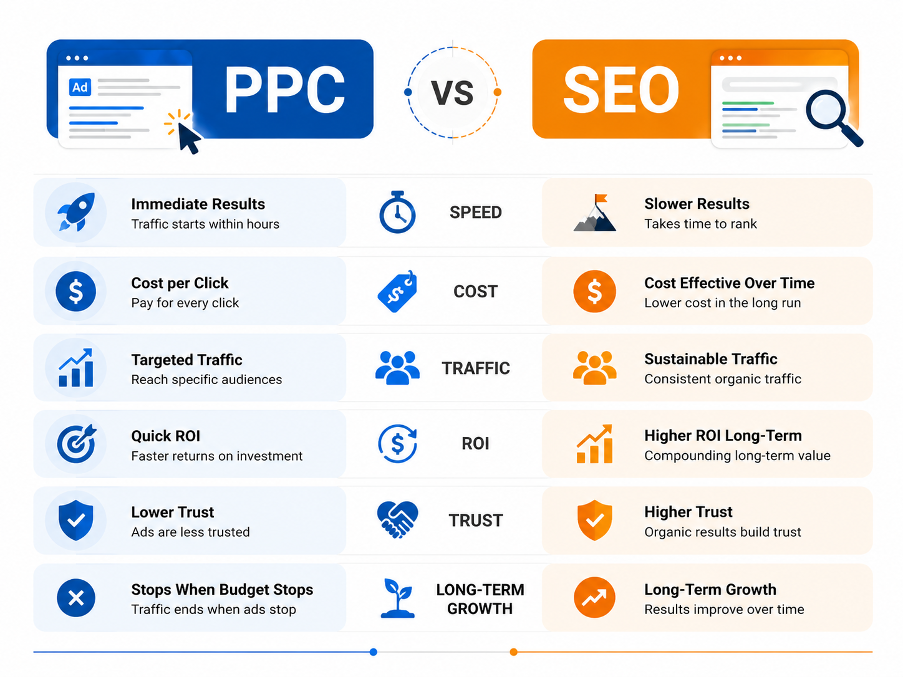
SEO usually has higher upfront effort but lower marginal cost per click over time, while PPC has lower setup friction but ongoing cost for every visitor. That means SEO often improves ROI over the long run, while PPC can deliver faster but more budget-sensitive returns.
The timeline difference is the most important practical factor. PPC can drive traffic within hours, but SEO can take weeks or months before meaningful rankings appear. In many cases, the best ROI comes from using PPC for immediate demand capture and SEO for compounding visibility.
Small Businesses and B2B
For small businesses, the choice between PPC vs SEO the choice depends on cash flow and urgency. If revenue must come quickly, PPC can create immediate pipeline, but if budgets are limited, SEO may be the safer foundation because it can lower acquisition costs over time.
For B2B companies, SEO often has a strong advantage because buyers research extensively before contacting sales. Educational content, comparison pages, and problem-solving pages can support long sales cycles, while PPC works best for retargeting, high-intent terms, and bottom-of-funnel offers.
Final Verdict
Depending on the demand of business and goals choosing wisely PPC vs SEO is important .If you need results now, invest in PPC first. If you want compounding growth and can wait for momentum, invest in SEO first. The strongest strategy for most businesses is to start with the channel that matches your current business constraint, then build the other alongside it once the first channel begins producing data and revenue.
For a new business with no traffic and no proof of demand, PPC is often the faster learning tool. For an established business that wants lower acquisition costs and long-term visibility, SEO is usually the better first investment.
For more information , stay tuned to growth clicksAbout
