

A strong lead generation strategy is the difference between a business that grows predictably and one that relies on luck. This guide walks you through every stage — from attracting strangers to converting them into paying customersWhy Your Lead Generation Strategy Is Everything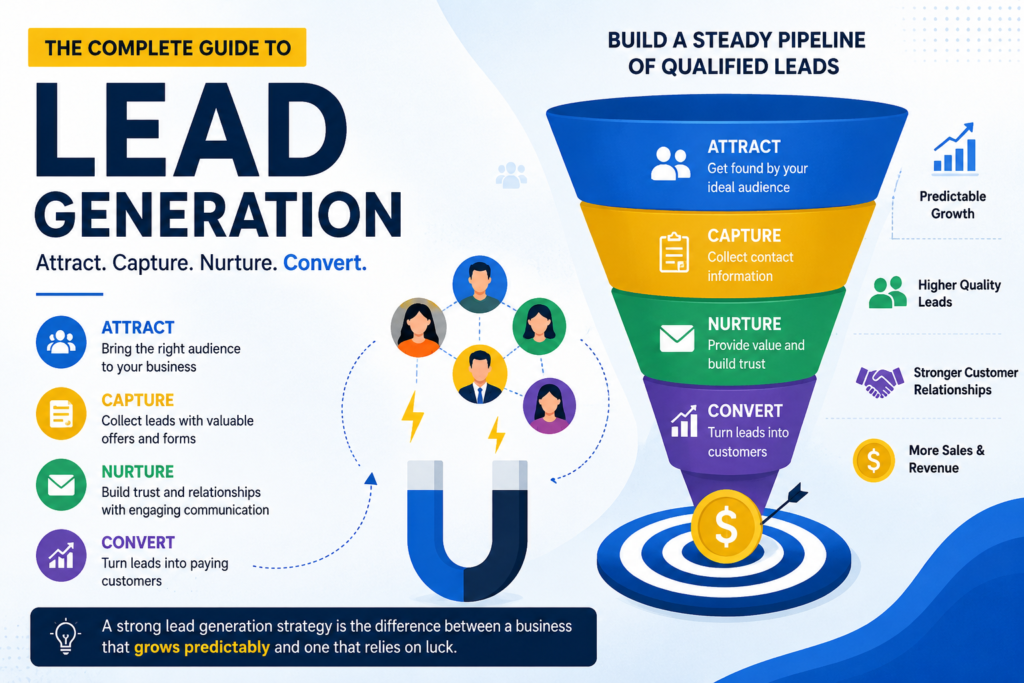
Most businesses don’t have a sales problem. They have a pipeline problem. When revenue stalls, the first place to look is your lead generation strategy — specifically, whether you have one at all, or whether you’re just hoping referrals keep coming.
A lead generation strategy is a repeatable system for attracting potential customers, capturing their interest, and moving them toward a purchase. Without one, you’re leaving growth to chance. With one, you control the inputs that drive revenue.
The best lead generation strategy today combines inbound (people find you) and outbound (you reach out to them) across multiple channels. Neither alone is enough. Together, they build a resilient pipeline that doesn’t dry up when one channel underperforms.
Stage 1: Awareness — Be Where Your Buyers Are
Every effective lead generation strategy starts with visibility. Before anyone can become a lead, they need to encounter your brand at the right moment.
Organic search and content marketing are the foundation of any long-term lead generation strategy. Writing in-depth, genuinely useful content that targets the questions your buyers are searching answers creates traffic that compounds over time. A well-ranked article can generate leads for years without additional spend.
Paid advertising accelerates visibility when you need results faster. Google Search Ads capture high-intent buyers already looking for a solution. LinkedIn Ads let you reach B2B decision-makers by job title and company size. Meta and Instagram Ads work at scale for consumer brands and top-of-funnel awareness.
Social media and community building extend your reach organically. Pick one or two platforms where your audience actually spends time and show up consistently — sharing insights, engaging with comments, and building credibility over months and years.
The goal at this stage is simple: get the right people to your website or content. Everything else follows from there.
Stage 2: Capture — Give People a Reason to Raise Their Hand
Traffic without conversion is wasted effort. The second pillar of a solid lead generation strategy is giving visitors a compelling reason to share their contact information.
Lead magnets are the workhorse of most lead generation strategies. A lead magnet is something valuable — a template, a calculator, a detailed guide, a free tool — offered in exchange for an email address. The key is specificity: the more precisely your lead magnet addresses a single, urgent problem, the higher your conversion rate will be.
Landing pages should do one thing only: convert the visitor. Remove navigation menus, limit distractions, and make the value of your offer impossible to miss. Your headline should state the benefit the visitor receives, not what you do as a company.
Webinars and interactive content — assessments, quizzes, graders — consistently outperform static PDFs in both conversion rate and lead quality. Someone who registers for a 60-minute event on your topic is a far warmer prospect than someone who passively downloaded a checklist.
Live chat and chatbots capture leads in real time, especially on high-intent pages like pricing or product pages. They answer objections in the moment and can collect an email before a visitor decides to leave.
The right mix depends on your audience and buying cycle, but every lead generation strategy needs at least one strong capture mechanism working at all times.
Stage 3: Nurture — Build Trust Before You Ask for the Sale
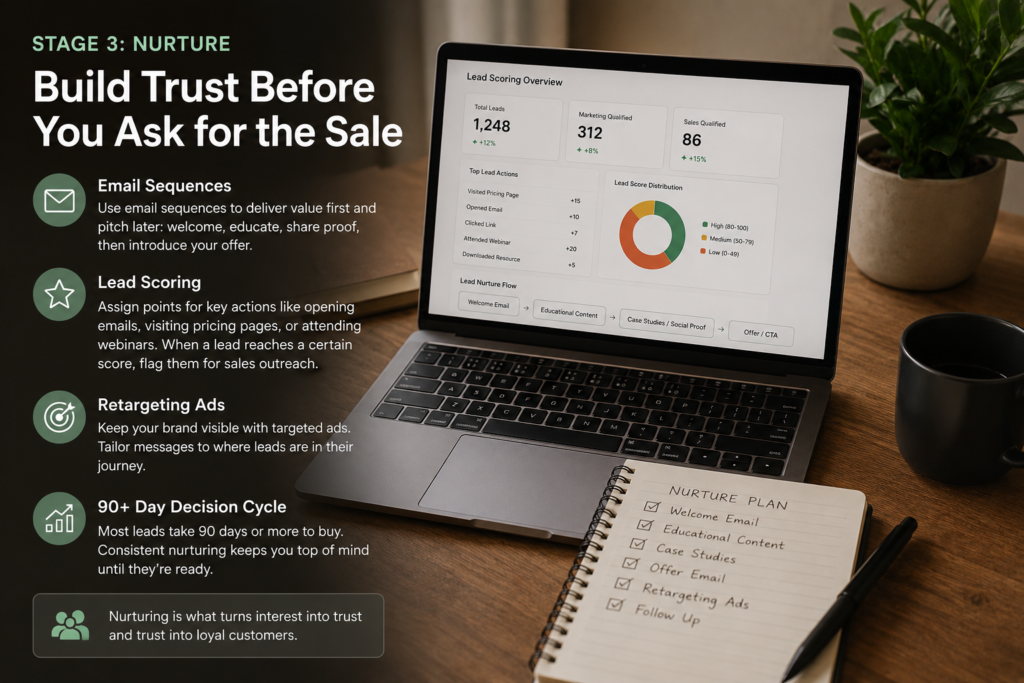
Most leads are not ready to buy immediately. Research consistently shows that the majority of leads who eventually convert take 90 days or more to make a decision. A lead generation strategy without a nurturing component is one that wastesmost of its investment.
Email sequences are the most effective nurturing tool available. Structure them to deliver value first and pitch later: start with a strong welcome that delivers what you promised, move into educational content, share social proof and case studies, then introduce your offer once trust has been established.
Lead scoring helps you prioritise. Assign points to actions that signal buying intent — visiting your pricing page, opening multiple emails, attending a webinar. When a lead crosses a defined threshold, flag them for sales outreach. This prevents your team from chasing cold contacts while warm prospects go unnoticed.
Retargeting ads keep your brand visible as leads browse elsewhere online. Show different messages to different segments — someone who visited your pricing page is much further along than someone who only read a blog post.
Nurturing is the stage where a good lead generation strategy separates itself from an average one. Anyone can collect email addresses. The businesses that win are the ones that consistently move those contacts closer to a decision.
Stage 4: Qualify — Focus Your Energy on the Right Leads
A lead generation strategy that sends every contact straight to sales is inefficient and demoralising for your sales team. Qualification filters out the browsers so your team can focus on genuine buyers.
The two most important distinctions in any lead generation strategy:
- MQL (Marketing Qualified Lead): has met an engagement threshold — downloaded content, visited key pages, opened emails. Interested, but not necessarily ready to buy.
- SQL (Sales Qualified Lead): has shown buying intent — requested a demo, asked about pricing, or been validated by a sales conversation.
The classic BANT framework helps evaluate readiness: Does the prospect have the Budget? Are they the Authority to make the decision? Do they have a genuine Need? And what’s their Timeline?
A lead that scores well on all four becomes an immediate priority. Others return to nurture until conditions change.
Stage 5: Convert — Close With Confidence
The final stage of your lead generation strategy is where pipeline becomes revenue. A lead that has been nurtured well arrives at a sales conversation already educated, already trusting you, and already partway convinced.
Discovery calls should lead with questions, not a pitch. Understand the prospect’s situation, the problem they’re trying to solve, and what success looks like to them. People buy from those who understand them.
Tailored demos outperform generic product walkthroughs every time. Build each demo around the prospect’s specific industry, team size, and stated challenges.
Persistent follow-up closes deals. Most sales happen after the fifth to eighth follow-up — most salespeople give up after the first or second. Build a structured cadence and stick to it.
Metrics That Reveal Where Your Lead Generation Strategy Is Leaking
| Metric | What it tells you |
|---|---|
| Visit-to-lead conversion rate | Landing page and offer quality |
| Cost per lead (CPL) | Channel efficiency |
| Lead-to-MQL rate | Audience targeting quality |
| MQL-to-SQL rate | Nurture and scoring effectiveness |
| SQL-to-close rate | Sales team performance |
| Customer acquisition cost (CAC) | Total funnel efficiency |
Review these monthly. Each drop points to a specific stage that needs attention — not the whole strategy.
Start Building Your Lead Generation Strategy Today
You don’t need to overhaul everything at once. Begin with the fundamentals:
- Audit your top traffic pages — do they have a clear call to action?
- Create one high-value lead magnet that solves a specific, urgent problem
- Set up a 5-email welcome and nurture sequence
- Define your MQL threshold so sales knows who to prioritise
- Implement basic lead scoring in your CRM
A great lead generation strategy is not built in a day. It’s built and refined over months, improving each stage incrementally. The businesses that consistently win are the ones that treat lead generation as an ongoing system — not a one-time campaign.
Start simple. Measure what matters. Keep iterating. Check out these links for further information.
Do contact us for a better lead generation with this link Home
Frequently Asked Questions
Q1: What is a lead generation strategy and why do I need one?
A lead generation strategy is a planned, repeatable system for attracting potential customers and moving them toward a purchase. Without one, your business depends on unpredictable referrals and word of mouth. With one, you can forecast pipeline, control acquisition costs, and scale growth consistently.
Q2: How long does it take to see results from a lead generation strategy?
It depends on the channels you use. Paid ads can generate leads within days. SEO and content marketing typically take 3–6 months to gain traction but deliver compounding returns over time. Most businesses see meaningful pipeline results from a combined strategy within 60–90 days.
Q3: What is the difference between an MQL and an SQL?
An MQL (Marketing Qualified Lead) has shown enough engagement — downloading content, visiting key pages — to be considered a potential buyer but isn’t yet sales-ready. An SQL (Sales Qualified Lead) has demonstrated clear buying intent, such as requesting a demo or enquiring about pricing, and is ready for a direct sales conversation.
Q4: How many leads do I need to hit my revenue target?
Work backwards from your goal. If your average deal size is ₹1,00,000 and your SQL-to-close rate is 25%, you need 4 SQLs to close one deal. If your MQL-to-SQL rate is 20%, you need 20 MQLs to get 4 SQLs. Use this reverse math to set monthly lead targets.
Q5: What’s the most cost-effective lead generation strategy for a small business?
Content marketing combined with email nurturing offers the best long-term ROI for most small businesses. It requires more time than money upfront, but a well-ranked article or a strong lead magnet can generate leads consistently without ongoing ad spend.
Q6: How do I stop leads from going cold?
Consistent, value-first follow-up is the answer. Most leads go cold because they receive a pitch before trust is established. A structured email nurture sequence — delivering useful content over several weeks before making an offer — keeps leads warm and increases the likelihood they reach out when they’re ready to buy.
Q7: Should I focus on inbound or outbound lead generation?
Both have a role to play. Inbound (SEO, content, social) builds long-term, scalable pipeline but takes time. Outbound (cold email, LinkedIn outreach, paid ads) generates faster results but requires ongoing investment. The strongest lead generation strategies combine both — using inbound to build authority and outbound to accelerate pipeline when needed.
Q8: How do I measure if my lead generation strategy is working?
Track these six metrics monthly: visit-to-lead conversion rate, cost per lead (CPL), lead-to-MQL rate, MQL-to-SQL rate, SQL-to-close rate, and customer acquisition cost (CAC). A drop at any stage points to a specific problem — whether that’s weak offers, poor nurturing, bad targeting, or a sales gap.
